The Legend of Pope Joan
 |
|---|
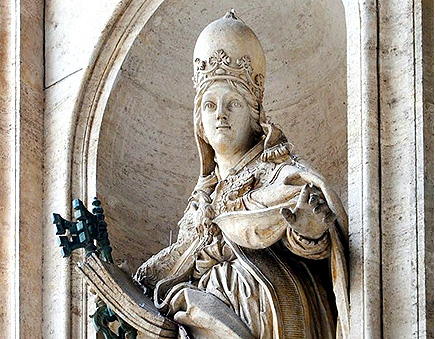
| A statue "somewhere in Rome," purported to be that of Pope Joan wearing the papal crown and holding the "keys to the Kingdom of Heaven" |
|
|---|
| A statue "somewhere in Rome," purported to be that of Pope Joan wearing the papal crown and holding the "keys to the Kingdom of Heaven" |
In the study of human behavior and philosophy, we humans are often confronted by the phenomenon of confirmation bias, the tendency to believe what we fervently wish were true, whether or not it actually is. Faked moon landings, Stolen elections. The "deep state. Magical stars that somehow motivated three kings to leave their kingdoms and bring gifts to a baby born in far off Bethlehem who got there shortly after he was born. Creationism. The Real Presence. The ancestry of the Blessed Mother We physicists, like lawyers, deal with evaluation of reality by methods that are intended to mitigate against confirmation bias. As it turns out, the universe doesn't care what we believe! How unfortunate for us! We have to find out everything about the universe for ourselves, using brains designed essentially to know what fruits to eat, what predators to avoid, and how to keep from falling out of trees!
My dictionary, that defines "legend" as an "unauthenticated traditional story sometimes popularly regarded as historical," confirms the assumption that the story of Pope Joan is at least a legend. I think that it is also a myth, "a misrepresentation of the truth, or a fictitious, imaginary, exaggerated or idealized conception of a person or thing." There are so many extremely unlikely aspects of this story that it is impossible to determine on what possible truth, if any, it was based.
Consider: Pope Joan supposedly reigned between 855 and 857, or 872 and 882, depending whom you ask, and abdicated, was deposed, or died afterward. Yet nobody seemed to know about it until the at least the 11th century. Why not? If Pope Francis was found to be a woman, and thus ineligible to receive the Sacrament of Orders, it would be front page news for at least a couple of weeks, but it is absurd to think that it could be covered up and then discovered only after 172 years!
The disguise of a woman as a man is a popular plot for a story. The 1983 film "Yentl" is about an Ashkenazi Jewish woman in Poland in 1904 who decides to disguise herself as a man so that she can receive an education in Talmudic law (not that much different from the story of Joan). It won an Academy Award for Best Original Song Score and the Golden Globe Award for Best Motion Picture - Musical or Comedy, and Best Director for its star, Barbra Streisand. It made her the first woman to win Best Director at the Golden Globes. It is based on Isaac Bashevis Singer's short story "Yentl the Yeshiva Boy."
"She's the Man" is a 2006 American romantic comedy teen sports film inspired by William Shakespeare's play "Twelfth Night," The film centers on teenager Viola Hastings, who enters her brother's new boarding school in his place and pretends to be a boy in order to play on the boys' soccer team. You can probably think of other stories with this theme.
Most versions of her story describe Joan as a talented and learned woman who disguised herself as a man, often at the behest of a lover. In the most common accounts, she somehow entered the priesthood. She then rose through the church hierarchy and was eventually elected pope. Her gender was revealed when she gave birth during a procession in which, fully dilated, she attempted to mount a horse and suddenly gave birth! She reportedly died shortly after, either through murder or of natural causes. To add insult to injury, the little bastard supposedly eventually became Bishop of Ostia and ordered her entombment in his cathedral when she died. I have not been able to find any corroboration, but that doesn't prove anything one way or the other. The accounts state that later church processions avoided this spot and that the Vatican removed the female pope from its official lists and crafted a ritual to ensure that future popes were male. In the 16th century, Siena Cathedral featured a bust of Joan among other pontiffs; this was removed after protests in 1600.
Arguments in favor of the story are; that it exists at all, that an educated woman's scholarly abilities might have been mistaken for that of a man, various anecdotes that can be explained much more logically by other arguments, and that a possible motivation for her associating with male clergy could have been because one (or more!) of them used her as a prostitute.
That rationale literally stinks! Modern prostitutes can make a very good income from being smuggled into military barracks: all the men suddenly become excessively horny from the unfamiliar pheromones! As a result, she does a land office business initially, but the presence of the woman, however well concealed, is quickly found out. I can tell you from my own experience that the effect of pheromones from a woman of childbearing age in a previously all male environment are impossible for healthy men to remain immune unless they are closely related! A strange woman that age in a cloister of sexually starved young men would likely cause a riot in short order!
In some versions, Joan was initially a famous educator with many students and high praise. So she would have to have started the masquerade long before she became associated with Roman clergy. This is not to say that there may not have been any number of females (prostitutes) who came and went around otherwise celibate clergymen, only that none of them is likely to have been confused with a man, let alone a male pope!
Groups of men, as a rule, often involve casual nudity. We tend to compare ourselves with each other, even subconsciously. Even if young Joan were always fully covered, that alone would be a dead giveaway that she wasn't normal. She would have had somehow to conceal her figure, her lack of facial hair, her missing Adam's apple, and her female voice. She would have had a totally distinctive female body odor. These would have been exacerbated by the fact that people of that time bathed rarely and even then rarely alone in isolation. She never, ever would have been observed urinating like a man, and she would have had to have been elected to the Papacy remarkably young!
Supposedly, Joan reigned between Leo IV and Benedict III in the 850s. However, Leo IV died 17 July 855, and immediately after his death Benedict III was elected by the clergy and people of Rome; but, owing to the setting up of an Antipope, in the person of the deposed Cardinal Anastasius, he was not consecrated until 29 September of that year. Coins exist which bear both the image of Benedict III and of Holy Roman Emperor Lothair I, who died 29 September 855; therefore Benedict was probably recognized as pope before the last-mentioned date. On 7 October 855, Benedict issued a charter for the Abbey of Corvey, so he was installed before that date. Several other historical witnesses prove the correctness of the dates given in the lives of Leo IV and Benedict III. There was no interregnum between these two Popes, so there is no room for Joan in that time period. Neither is there between Benedict III, who died on 17 April 858, and Pope Nicholas I, who reigned between 24 April 858 until his death on 13 November 867.
Most of the arguments I have seen are based on the dates of coins supposedly minted in the 850's, the authenticity of which is at least questionable.
I find it interesting that the whole story comes to light after the Great Schism, which began in 1054. when the Roman Pope and Byzantine Patriarchs were spending a lot of their time excommunicating each other and trying to prove each other to be illegitimate claimants to the Chair of Peter. The story of duplicitous, heretical, blasphemous, fornicating, mortally sinful "Pope" Joan fits nicely into the chaos of the times, but not really before.
Some other arguments are:
Medieval popes reportedly avoided traveling the direct route between the Lateran and St. Peter's. The origin of the practice is uncertain. The supposed widespread belief that it had something to do with the shame of the Joan legend, is thought by some to have dated back to that period. It could have had any number of causes, including the most likely one of broken paving stones or potholes that would have been a hazard to horses.
There are several examples of "sediae stercorariae" or "dung chairs" containing a hole, that were supposedly used somehow (by somebody!) to verify the male genitalia of those sitting on them (under all those robes)! There is supposedly one at St. John Lateran (the formal residence of the popes and center of Catholicism), the Louvre museum, the Vatican Museums, and possibly elsewhere. The purpose to make sure the occupant was a man, seems much less likely than the fact that Cardinals are almost all old man (much older than a woman of childbearing age) and toilet paper and Preparation H had yet to be invented. Such chairs might have been useful for long deliberations among old men with prostate trouble or if they had potty bowls under them! I think the most logical explanation of the existence of the chairs is that they used to have washable cushions in them and the hole made the chairs extra cushiony.
I think the whole story started after the Great Schism and has likely been perpetuated by the Reformation. I first heard about it from a Protestant neighbor of mine who considered that the Pope was the Antichrist, apparently a tenet of his own religion.
I place the Legend of Pope Joan as credible as the modern interpretation of the "Three Wise Men," the "Fake Apollo Program," and the "parents of the Blessed Mother."
|
|---|
|
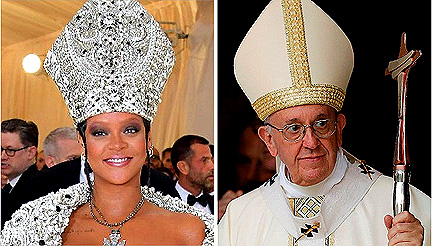
Two celebrities. Rihanna, who is a woman but not a pope, costumed at the Met Gala of 2018, and Pope Francis, who is a pope but not a woman, in his working clothes. The Met Gala theme was "Heavenly Bodies: Fashion and the Catholic Imagination," intended to honor the ways the Catholic church has inspired fashion designers. Some people found the whole thing offensive, but I think Ri-Ri nailed it! |