 | 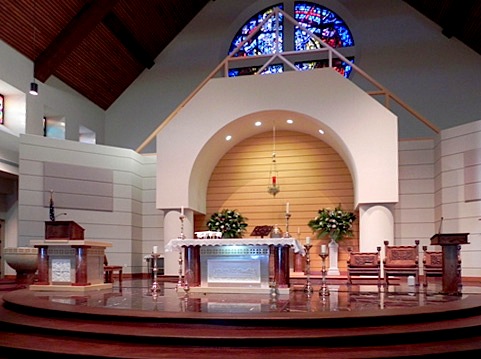 |
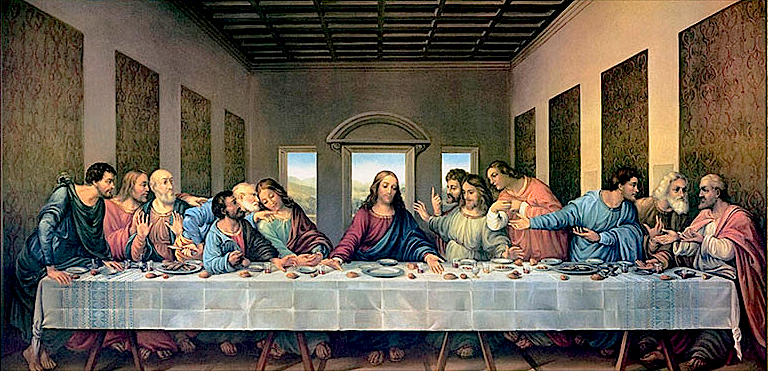
| A restoration of "The Last Supper" by Leonardo da Vinci | The altar is the focal point of Catholic churches |
|---|
| |
| A restoration of "The Last Supper" by Leonardo da Vinci | The altar is the focal point of Catholic churches |
|---|
Catholics believe that the bread and wine become the real body and blood, soul and divinity, the actual living person, of Jesus Christ, the Son of God, by which he fulfills the promise to be "with you always, even unto the end of the world." Matthew 28:20, as explained previously by his promise, "...The bread that I will give is my flesh, which I will give for the life of the world...Except ye eat the flesh of the Son of man, and drink his blood, ye have no life in you. Whoso eateth my flesh, and drinketh my blood, hath eternal life; and I will raise him up at the last day." John 6:51, 53, 54 This belief is also known as the Real Presence of Christ in the Eucharist, or simply, the "Real Presence."
| KJV Scriptural Bases for the Catholic Eucharist | |||
|---|---|---|---|
| Matthew 26:26-28 | Mark 14:22-24 | Luke 22:19-20 | 1 Corinthians 11:23-26 |
| And as they were eating, Jesus took bread, and blessed it, and brake it, and gave it to the disciples, and said, Take, eat; this is my Body. And he took the cup, and gave thanks, and gave it to them, saying, Drink ye all of it; For this is my Blood of the new testament, which is shed for many for the remission of sins. |
And as they did eat, Jesus took bread, and blessed, and brake it, and gave to them, and said, Take, eat: this is my Body. And he took the cup, and when he had given thanks, he gave it to them: and they all drank of it. And he said unto them, This is my Blood of the new testament, which is shed for many. |
And he took bread, and gave thanks, and brake it, and gave unto them, saying, This is my Body which is given for you: this do in remembrance of me.* Likewise also the cup after supper, saying, This cup is the new testament in my Blood, which is shed for you. |
For I have received of the Lord that which also I delivered unto you, That the Lord Jesus the same night in which he was betrayed took bread: And when he had given thanks, he brake it, and said, Take, eat: this is my Body, which is broken for you: this do in remembrance of me.* After the same manner also he took the cup, when he had supped, saying, This cup is the new testament in my Blood: this do ye, as oft as ye drink it, in remembrance of me.* For as often as ye eat this bread, and drink this cup, ye do shew the Lord's death till he come. |
*The Eucharist is therefore submission to the will of God; a fulfillment of a mandate of Christ himself. We admit that it is a mystery, not just difficult, but impossible fully to understand. His disciples had difficulty with it, too. Scripture records that "Many therefore of his disciples, when they had heard this, said, 'This is an hard saying; who can hear it?'"
The Mass is a ceremony of the consecration of the Eucharist, which may be thought of as the Last Supper with associated prayers and Scriptural readings. Its establishment history is celebrated once a year during the week before Easter, specifically Holy (or "Maundy") Thursday. There are other ceremonies associated with this anniversary, such as foot washing and memorialization of the other events leading up to the Crucifixion, but the Mass itself is celebrated millions of times every day and week, all over the world. The feast of Corpus Christi ("The Body of Christ") is celebrated nine weeks later, or the Sunday immediately following, in the western world
Catholics believe that the Last Supper, the Crucifixion, and each Mass are spiritually the same event. By this mystery, the followers of Jesus, at all times and in all places, from the Apostles to all living Christians everywhere, have the opportunity to be physically present as witnesses to the one, single event of the salvation of mankind by Jesus Christ, the Son of God. It is the focus of Catholic worship. The altar, on which this sacrifice is commemorated and the bread and wine are consecrated to become the body and blood of Christ, is also a Last Supper table, the focal point of every Catholic church.
We realize that this belief is not shared by all Christians. The formal belief of our Baptist brothers and sisters, for example, Paragraph 2 of Chapter 30 of the 1689 Baptist Confession of Faith states emphatically:
In this ordinance Christ is not offered up to his Father, nor any real sacrifice made at all for remission of sin of the quick or dead, but only a memorial of that one offering up of himself by himself upon the cross, once for all; and a spiritual oblation of all possible praise unto God for the same. So that the popish sacrifice of the mass, as they call it, is most abominable, injurious to Christ's own sacrifice the alone propitiation for all the sins of the elect.The references given are Hebrews 9:25, 26, 28, I Corinthians 11:24 and Matthew 26:26, 27.
Catholics, of course, agree with Baptists about what Scripture says, but not, in this case, how their Confessions of Faith interpret it. The reference to Hebrews points out that Christ does not offer sacrifice over and over again, as the high priests did in the Old Testament, but only once, for all time. We agree with that. Catholic belief that the Last Supper, the Sacrifice on the Cross and each mass are the same event agrees with this view, as noted in the foregoing.
In addition, we note that I Corinthians does not claim that Jesus said, or in any way even implied, "this represents my body," or "this is a memorial of my body." What he said was, "This is my body ... this is my blood..." The same observation applies to the Reference to Matthew, Mark and Luke, as noted above. If Scripture is to be believed, it is difficult to conclude other than that the bread and wine (note: wine) that Jesus blessed had become his own, personal physical body and blood, that were about to be given to the Apostles and later sacrificed for them on the Cross, as he himself specifically stated. Either the Confessions are wrong, or Jesus (and we) are.
We note that Jesus previously promised that he would give his flesh to eat and blood to drink in John 6:51-57. When his hearers claimed it was a "hard saying," He did not claim, or even hint, that they misunderstood him, but reiterated, "my flesh is meat indeed, and my blood is drink indeed," and that those who ate would live forever. We maintain, based clearly his own words, that "the Lord's Supper" is the fulfillment of that promise.
The implications for Catholics are that, since Jesus said to "do this," Christian ministers (priests and bishops) are obligated to take bread and wine and say the words he said over them. We believe that by his power as God the Son, passed on through the laying on of hands in unbroken succession from the Apostles to his ministers today, the bread and wine thereby become the actual and true body and blood of the risen and glorified Christ as he clearly said! This is known as "transubstantiation," the instantaneous change of substance, but not the appearance, of the bread and wine. Saint Paul reminded the Christians of Corinth, if there was any doubt, that what they were doing was the same thing, and had the same effect, as when Jesus did it. (I Corinthians 11:23-25)
The word "transubstantiation" is not mentioned in Scripture. It is a word first used in the in the canon "De Fide Catholica" (About the Catholic Faith) of the Fourth Lateran Council It describes an event that occurs during the mass (and occurred during the Last Supper) when the celebrant, the priest or bishop say (or Jesus said) over the bread and wine, "this is my body" or "this is my blood," in whatever language is being spoken. After these words are spoken (or sung, in the Eastern Rite), Jesus becomes personally present on the altar under the appearance of the bread and wine, as he is quoted as saying, above, and nothing remains of the former reality of bread and wine. We admit that we don't understand it, but we believe it because Jesus said so.
Impossible? I might think so if I didn't accept the truth of Scripture as noted in the foregoing references and that "With God all things are possible. Since I do consider Scripture to be the true word of God, I don't have a problem with it.
For those who point out that there is no scientific evidence for this belief, our reply is that science applies only to the physical universe, and transubstantion is one hundred percent spiritual. For this reason, results of efforts to measure spiritual things, such as the weight of the human soul by weighing people before and after they died, have not been encouraging. We Catholics are not bothered by the fact that unconsecrated communion wafers are not perceptibly heavier after consecration than before.
Catholics maintain, from Scripture, that since the Eucharist consists of the body and blood of Christ, who is also God, it is the same body and blood, that was offered on the cross, and the same risen body and blood that now reigns gloriously and immortal with the Father in paradise. And because now Christ is living and glorified, this body and blood are reunited, by which he is present, living, whole and entire, body and blood, humanity and divinity, under the appearance of either bread or wine, or both together. By partaking of the Lord's Supper, therefore, we are able to partake of the same, single, unique sacrifice of Christ for the redemption of all mankind.
The act of reception of communion by Catholics is a public demonstration of this belief, signified by the minister announcing, "The body (or, in the case of the cup, "the blood") of Christ," and recipient saying, "Amen."
The official teaching of the Catholic Church on the Eucharist can be found on the Vatican website for those interested. Older Catholics like me may remember learning about the Eucharist in Catholic school from the Baltimore Catechism of 1941, Lesson 26.
The word "sacrifice" in English comes from the Latin: "to make holy, or sacred." The idea is as old as human history, and exists in many cultures. There is a Wikipedia article about it. It is essentially an act of giving up something, such as the life of an animal or human, to please God or to make reparation for sin, which is what the crucifixion of Christ is all about. Most Jews, Christians and Muslims know the story of Abraham being willing to make a sacrifice of his son (Ishmael or Isaac) to please God (Genesis 22:2 and following). But they agree on the basics, which involve killing a healthy victim and then burning or roasting it. Variations on this theme include a much more recent popular fictional story of Luana, a South Seas native daughter of the local chieftain, leaping to a fiery death to placate the volcano gods in the play "Bird of Paradise" by Richard Walton Tully, and two motion pictures of the same name.
What might be less universally understood, however, is that in most cases, the animal carcass is not wasted: part of it is eaten by the priests or the community. Almost all of the Book of Leviticus, the third of the Old Testament, is devoted to the rules for ritual sacrifices. The word "sacrifice" appears in the King James Version of Leviticus 46 times, and "eat" 56 times. The first book, Genesis, recounts the story that Melchizedek, a "priest of the most high God" and King of Salem, "brought forth bread and wine: and ... blessed him (Abram), and said, 'Blessed be Abram of the most high God, possessor of heaven and earth.'" This suggests (but does not prove) the use of bread and wine as a sacrifice for Abram's victory over his (and Salem's) enemies. The use of bread and wine allows the things offered to be eaten without killing anything, perhaps a welcome relief for soldiers who had just won a bloody, hand-to-hand battle and were no doubt sick and tired of bloodshed.
So the idea of eating a sacrificial victim was well established in Jesus's time. The idea of the victim proposing to be eaten was obviously not! John 6:60 asserts that his listeners didn't even want to hear such a thing! A "hard saying," indeed!
Which brings up an interesting allegation that seems to have been made by pagans against the early Christians, and some modern Protestants against Catholics, regarding the belief that the Eucharist is indeed "the body of Christ," which we proclaim every time we receive it. "Are Catholics cannibals?"
I asked Google AI this question, and got what I think is the right answer: "The Eucharist is not considered cannibalism because it involves consuming the living, resurrected body and blood of Christ under the appearance of bread and wine, rather than dead human flesh. It is a sacramental, non-violent, and spiritual act where Christ offers himself voluntarily, and he is not diminished or killed in the process." Here are the key distinctions:
"Essentially, the Eucharist is considered a mystery of faith that unites the believer with the living Person of Jesus, rather than a mere biological consumption of human meat."
Frankly, I don't think it matters. Jesus said we should do it, he told us to do it, he did it with his apostles, and commissioned them to do it in remembrance of him. I personally think it was really clever of him to have made it possible to be united with him so intimately in so innocuous a manner, using provender produced by human labor that one would ordinarily eat and drink anyway, to make it so easy for all human beings to accept. He thus satisfies the desire for that union with the divine that other believers as well as Catholics all share.
I find it interesting, but not particularly important, that bread and wine are (1) available just about anywhere, including in the Apollo 11 vehicle (when Buzz Aldrin had a private communion service shortly after lunar landing), and that (2) both of them are a combination of "fruit of the earth/vine and work of human hands" (or feet, in the case of the wine), so that each reception of the Eucharist is a collaboration of high tech food making by humans and a spiritual act of Almighty God.
Isn't God clever?