Lady Cardinals?
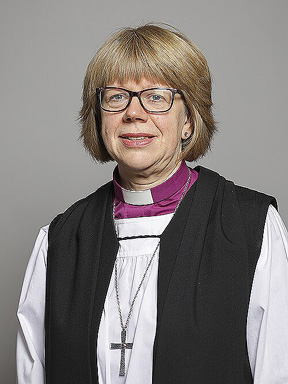 |
|---|
| The Right Reverend and Right Honourable Dame Sarah Mullally, DBE, 106th Archbishop of Canterbury, Member of the House of Lords and Lord Spiritual |
|
|---|
| The Right Reverend and Right Honourable Dame Sarah Mullally, DBE, 106th Archbishop of Canterbury, Member of the House of Lords and Lord Spiritual |
Every once in a while, I encounter the subject of female clergy, now that religions other than Catholicism have some. The main arguments, pro and con, seem to be the same as those regarding the practice of obstetrics versus the process of having babies. I would like to examine the subject from a different perspective.
On March 26, 1962, while I was cramming for my oral comprehensive exams at Loyola University in New Orleans, a truly remarkable person was being born in Woking, Surrey, England, Sarah Elisabeth Bowser, who would grow up to become the first woman to hold the office of Archbishop of Canterbury the highest clerical office in the Anglican Church.
Having become a Christian at age 16, future Archbishop Mullally was ordained a deacon in 2001, and a priest in 2002, and consecrated a bishop in 2015. Previously, as a joint Registered General Nurse (RGN) with bachelor's and master's degrees in nursing, she had been chief nursing officer and director of patient experience for NHS England, the youngest person to hold these positions. She was appointed Dame Commander of the Order of the British Empire (DBE) in recognition for her contribution to nursing and midwifery.
I became acquainted with Anglican lady ministers in 1991, a year before the Anglican church began ordaining them, and six years before the Episcopal church in the United States did so. This minister was a lady Episcopal warden who was, fortunately, serving as the hospital chaplain where my grandson Braxton was born three months premature. Because he was not expected to live more than a few hours after birth in spite of truly heroic care, my daughter asked her to baptize him with the "one baptism for the forgiveness of sins" all Christians share. We watched as she baptized him in the NICU the same way we Catholics do. The assigned Catholic chaplain at the time was away doing something he considered more important than being available to baptize a dying person into the Church in a hospital, a place where people tend to die a lot.
A while later I met her again, this time when she had been ordained a deacon. She remembered me instantly as the grandfather of the first infant she had ever baptized! She expressed regret that the Catholic Church, that had been ordaining permanent (male) deacons since 1967, did not recognize the legitimacy of her own ordination and sacred ministry.
The Catholic Church is pretty inflexible about its stance on the possible ordination of women. In a 1994 apostolic letter Ordinatio Sacerdotalis, Pope John Paul II was emphatic that:
Wherefore, in order that all doubt may be removed regarding a matter of great importance, a matter which pertains to the Church's divine constitution itself, in virtue of my ministry of confirming the brethren (cf. Lk 22:32), I declare that the Church has no authority whatsoever to confer priestly ordination on women and that this judgment is to be definitively held by all the Church's faithful.That seemed pretty definitive to me, but there were a number of Catholic (?) theologians who began to nitpick the manner in which this belief was promulgated, and expressed doubt that the pope really meant what he said about being "definitively held." In response, he approved a reply issued by the Congregation for the Doctrine of the Faith (now called the Dicastery for the Doctrine of the Faith) that this teaching had been "set forth infallibly by the ordinary and universal Magisterium" and accordingly was "to be held definitively, as belonging to the deposit of faith." The pope apparently believed that he had been sufficiently clear that he personally didn't need to repeat himself to people who really didn't want to listen anyway.
Did that end the controversy? Not on your life!
From time to time, questions arise from various sources regarding the legitimacy of ordaining women, including wives and mothers, to the diaconate now that we have permanent deacons who are husbands and fathers. The current confusion seems to arise from the translation of the term "priestly ordination" from the Latin sacerdotalis ("priestly") which some people claim does not apply to "deaconly" ordination (and, by implication, perhaps, to "bishoply" ordination as well). A most recent discussion on the matter has been the release of a report by Pope Leo XIV. It examined the proposal of lady deacons with apparent intent of discovering whether there were any loopholes to be exploited to get around the official "to be held definitively" position. Nevertheless, Catholic deacons are considered ordained ministers who receive the same sacrament as do our priests and bishops.
On June 12, 2011, "All Things Considered" on National Public Radio reported that in 2002, seven women were secretly ordained as priests by two Roman Catholic bishops in Germany and those seven women went on to ordain other women, apparently as deacons as well as priests. This established a precedent for ordination of Catholic women (and perhaps the ordination of women by priests) in defiance of the aforementioned "definitively held" held Catholic teaching and Canon 1024 of the Code of Canon Law that: "A baptized male alone receives sacred ordination validly" that does not recognize ordination of any women, regardless of who attempts to do it. With all due respect to His Holiness Pope Leo IV (whom I still think of as "Pope Bob"), Canon 1024 does not confine its remarks to "priestly" ordination. It thus renders moot (hopefully once and for all) the question, "Can the Catholic Church ordain women to any office?" The answer is "No."
(There is a body of Lutheran thought that one "cannot receive 1/3 of a sacrament," and that the ordination of priests who are deacons or bishops who are priests is unnecessary, superfluous, and basically "papist." I have never heard convincing arguments either way but the question is moot regarding women, at least for Catholics.)
The point of all this is that the Catholic Church does not consider itself to be able to ordain women, even though some in the Anglican and Episcopal Churches do. Whether or not it might be a good idea seems to be irrelevant, but this supports an obvious but perhaps unacknowledged, emotional bias of long standing among our exclusively male and mostly celibate clergy that "gettin' ordained" is "men's work." Of course, it is in the Catholic Church, but obviously not in others.
Regarding the others, One of my college instructors was a former Lutheran priest who converted to Catholicism. He expressed a desire to continue his priestly ministry as a Catholic. Since his Catholic bishop could not verify the apostolic succession of his Lutheran one, he ordained him conditionally, in that if he were validly ordained previously, it would be just going through the motions. If not, this "prayer and laying on of hands" would do the job. That seems right to me.
I think we should mind our own business about how the others go about designating their clergy. I don't hear a fuss about how one becomes a rabbi, imam, Protestant minister or practitioner in other religions, why should be concerned about how the Episcopalians or Anglicans become clergy in theirs? I agree with St. Peter, the very first pope. I perceive that God is no respecter of persons: but in every nation he that feareth him, and worketh righteousness, is accepted with him.
On the other hand, The fact that we are still devoting time and other resources to examining the question suggests that there might be an accommodation to appointing women to positions in the Church they do not now occupy without ordination. I think that the controversy could be put to rest by establishing an order of (female, not ordained) deaconesses. Deacons are ordinary ministers of sacraments for which there are also legitimate (non-ordained) extraordinary ministers (baptism, Eucharist, and, as provided by Code of Canon Law Canon 1112, such as matrimony), who can be women. Like firefighters, the other functions of Catholic deacons appear to be as appropriate for women as well as men. The appointment to perform essentially the same service in the Church as the deacon appears to be canonically authorized now under appropriate circumstances for no greater effort than that the local bishop chooses to appoint (not ordain) them.
I personally would like to see that happen. My experience with the baptism of my grandson who might have died a pagan without the ministry of the lady who did that seems to me to be sufficient proof that this would be a good idea. I think that the potential for confusion about the matter could be resolved by the fact that, if this were done, deacons (both genders) of other faiths could be recognized as being ordained ministers in their faith, Catholic deacons would be ordained men, and Catholic deaconesses would be unordained women having basically the same functions, in ours. The difference would be much the same as that between British knight and dame in that they are roughly equivalent except that women do not go through the ceremony of being "knighted." I believe the time has come!
The most compelling argument for the incorporation of women into liturgical functions now completely dominated by men is from God Himself! The Book of Genesis records that on each day that God created things, He looked upon His handiwork and "saw that it was good." (Genesis 1:4, 10, 12, 18, 21, 25, 31. He withholds His judgment in the creation of man, "In His own image...male and female," in Genesis 1:27, but saw that "every thing that He had made," was "very good" on the sixth day in Genesis 1:31.) This presumably includes men and women, both of whom, together, after all, are "in His image. How could they be otherwise? The emphasis here seems to be on equality of the goodness of each of the genders, and possibly the similarity to the image of God being in both of them.
But the clincher is Genesis 2:7 ff, which examines the creation of the human race in more detail. God creates the man first, and for the first time ever sees that something is not good (Genesis 2:18). He rectifies this by creating the woman, thus fulfilling His plan to make us "in His image."
All this gives credence to the fact that Scripture considers women an integral and necessary part of human activity, not just the making of homes and the birthing of babies. I believe that this extends to service within the Church, including the exceptionally important activity of electing the pope. The men have been doing a reaconably job so far, but Scripture itself says that they should not be the only ones involved. God Himself decreed that it was "not good" that they do it alone, not being eligible for ordination notwithstanding!
Regarding lady cardinals, (Catholic) Cardinal Vincent Nichols, Archbishop of Westminster and President of the Catholic Bishops' Conference of England and Wales, reportedly welcomed the announcement that the Bishop Dame Sarah Mullally will be the next Archbishop of Canterbury:
"On behalf of the Catholic Bishops' Conference of England and Wales, I welcome the news of the appointment of Bishop Sarah Mullally as the next Archbishop of Canterbury.In a letter addressed to Bishop Mullally, (Catholic) Cardinal Kurt Koch, President of the Dicastery for Promoting Christian Unity, was reported by Vatican News to have offered his congratulations and expressed the Catholic Church's support for her new ministry:"She will bring many personal gifts and experience to her new role. The challenges and opportunities facing the new Archbishop are many and significant. On behalf of our Catholic community, I assure her of our prayers.
"Together we will be responsive to the prayer of Jesus that we 'may all be one' (John 17:21) and seek to develop the bonds of friendship and shared mission between the Church of England and the Roman Catholic Church."
"Having learned of your nomination... I write to congratulate you on your appointment and to express the good wishes of the Catholic Church to you as you prepare to undertake this important service in your Church. I pray that the Lord will bless you with the gifts you need for the very demanding ministry to which you have now been called, equipping you to be an instrument of communion and unity for the faithful among whom you will serve,"Cardinal Koch highlighted the long-standing theological dialogue between the Anglican Communion and the Catholic Church, noting that it has fostered mutual understanding and affection over nearly sixty years. He recalled the warmth of relationships between the two communions, particularly after the death of Pope Francis earlier this year, and expressed hope that this closeness would continue:
"It is my fervent hope that such closeness may continue in the years ahead as we continue to walk together on the way. With the assurance of my prayers for you and your family," - Cardinal Kurt Koch
One should probably note that both of these congratulatory letters was about Archbishop Mullally's position, duties and responsibilities in the Anglican Church, for which the Vatican itself apparently considers her, as an Anglican, eminently (a little inside Catholic humor, there, folks) qualified.
This brings up an interesting question: what about lady Catholic cardinals?
Cardinals are, after all, papal electors. That's it! Of course, appointment to that position is a very high honor indeed, and is traditionally conferred only upon high ranking members of the clergy, who must be Christian males, as noted previously. Current canon law requires cardinals to be at least priests, and accept consecration as bishops upon appointment so that, if elected pope, the Bishop of Rome, they may immediately assume his duties. There are precedents otherwise, however:
On 19 December, 1736, in an obviously politically motivated act, Pope Clement II created (lay) Luis Antonio Jaime de Borbon y Farnesio, youngest son of King Philip V of Spain, cardinal deacon of Santa Maria della Scala, He previously had been named administrator of the temporal affairs of the Archdiocese of Toledo. He was eight years old at the time.
According to The New York Times, Pope Paul VI considered making the French Catholic philosopher Jacques Maritain a cardinal in 1965. Monsieur Maritain reportedly turned down the offer.
According to Wikipedia, although cardinals must be at least priests now, several men in history were not so ordained when they became cardinals, including
America Magazine, the Jesuit Review, published an article: Is the Catholic Church ready for women cardinals?" on April 21, 2022, that pointed out that lay and female cardinals are not beyond the realm of possibility now. The Code of Canon Law that currently prohibits this could be changed by a simple fiat of the reigning pope.
The article did not mention Dame Sarah Mullally, who was then the Bishop of London, or Katherine Jefferts Schori, who had been the Presiding Bishop of the Episcopal Church in the United States for nine years. Approximately 85 percent of all Catholic Church roles that do not require ordination are performed by women. Lady archbishops in the Anglican and Episcopal Churches demonstrated to the satisfaction of Vatican representatives that women can perform similar roles in the Church, too.
The argument that a lady cardinal could not be elected pope (the bishop of Rome) is specious at best. People who vote for US Government representatives do not have to be qualified for the office in question. Why should that be an issue? The pope is the Servus Servorum Dei, the servant of the servants of God. Females have represented very close to 50% of the world's Catholics and God's servants of other religions for a very long time. Shouldn't they be represented in electing a new pope?